Dominican International School recognizes that sports activities are an integral and valuable part of a student’s experience at school. We believe that an effective and inclusive athletics program can support students’ learning by developing:
It further creates opportunities to strengthen the school – student – parent – community bond.
By applying Christian principles in all extra-curricular activities, students no longer act only as individuals, but assume the obligations of being a member of a team and representative of the school. We must remember as coaches, players, fans and parents, that people will judge our athletics program and Dominican International School (DIS) by the Christian values that we display at each extra-curricular function.
Sports day is held annually during the last week of school. It is a one day event wherein students compete within each school in a friendly way. The student council is tasked to organize this event.
DIS Taipei participates in the tournaments established by Taiwan International Schools Sports Association (TISSA). DIS Taipei is a full member of TISSA. DIS Wolves compete in three different major sport disciplines - basketball, football, softball and volleyball, while swimming is the only minor sport. These events are held in various venues depending on the assigned host-school for every school year.
The lower and middle school sports program strengthens the vision of DIS Taipei in developing team spirit and sportsmanship that gives every student-participant a unique opportunity to share and develop their God-givent talent.
The lower school sports program schedule for the School Year 2025-2026 are as follows:
| Sports | Tournament Date | Division | Tournament Location |
|---|---|---|---|
| Swimming | September 26-27, 2025 | All | MAC |
| Cross Country | January 31, 2026 | All | MAK |
| Cross Country | March 14, 2026 | All | AST |
| Swimming | April 25, 2026 | All | KAS |
The middle school sports program schedule for the School Year 2025-2026 are as follows:
| Sports | Tournament Date | Division | Tournament Location |
|---|---|---|---|
| MS Swimming | September 26-27, 2025 | All | MAC |
| MS Football | November 8, 2025 | G8 Boys | MAT |
| G8 Girls | TES | ||
| G7 Boys | IIS | ||
| G7 Girls | MAK | ||
| G6 Boys | MAC | ||
| G6 Girls | MAC | ||
| MS Cross Country | November 22, 2025 | MS Boys and Girls | ICA |
| MS Volleyball | March 7, 2026 | G8 Boys | MAK |
| G8 Girls | KAS | ||
| G7 Boys | MAC | ||
| G7 Girls | MAC | ||
| G6 Boys | MAT | ||
| G6 Girls | MAT | ||
| MS Cross Country | March 14, 2026 | MS Boys and Girls | AST |
| MS Badminton | March 21, 2026 | MS Boys and Girls | TES |
| MS Swimming | April 25, 2026 | All | KAS |
| MS Basketball | May 9, 2026 | G8 Boys | MAC |
| G8 Girls | AST | ||
| G7 Boys | TES | ||
| G7 Girls | MAT | ||
| G6 Boys | IIS | ||
| G6 Girls | KAS |
The high school sports program focuses on friendship and teamwork. It supports the ideals of the school that sports activities are an integral and valuable part of a student’s experience at school.
Like the Middle School, High school students participate in TISSA tournaments. DIS Wolves compete in the three major events, basketball, volleyball and soccer. The minor events are ultimate frisbee, badminton, swimming and cross country.
The combined Asian Christian School / TISSA Track and Field Championship is the tournament were DIS Wolves compete. Track and field is a sport which includes athletic challenges established on the skills of running, jumping, and throwing. This sport has become a favorite among high school students because of the running skills.
The high school sports program schedule for the School Year 2025-2026 are as follows:
| Sports | Tournament Date | Division | Tournament Location |
|---|---|---|---|
| HS Swimming | September 26-27, 2025 | All | MAC |
| HS Tennis | October 18, 2025 | HS Boys and Girls | TES |
| HS Football | October 25, 2025 | JV Boys | MAK |
| HS Volleyball | November 1, 2025 | JV Girls | TES |
| HS Football | November 1, 2025 | V Boys | MAC |
| HS Volleyball | November 1, 2025 | V Girls | KAS |
| HS Ultimate Frisbee | November 15, 2025 | HS Boys and Girls | AST |
| HS Cross Country | November 22, 2025 | HS Boys and Girls | ICA |
| HS Badminton | January 17, 2026 | HS Boys and Girls | ICA |
| HS Basketball | January 24, 2026 | V Boys | MAC |
| HS Basketball | January 24, 2026 | V Girls | DIS |
| HS Basketball | January 24, 2026 | JV Boys | KAS |
| HS Basketball | January 24, 2026 | JV Girls | MAK |
| HS Cross Country | January 31, 2026 | HS Boys and Girls | MAK |
| HS Table Tennis | March 7, 2026 | HS Boys and Girls | IIS |
| HS Cross Country | March 14, 2026 | HS Boys and Girls | AST |
| HS Track and Field | March 27-28, 2026 (Tentative) | HS Boys and Girls | MAC |
| HS Softball | April 18, 2026 | HS Boys and Girls | KSS |
| HS Football | April 25, 2026 | JV Girls | TES |
| HS Volleyball | May 2, 2026 | JV Boys | MAK |
| HS Volleyball | May 2, 2026 | V Boys | MAT |
| HS Football | May 2, 2026 | V Girls | KAS |
The School clubs fall within the framework of extra-curricular activities. Clubs, an extension of the academic curriculum, is where the students have the opportunities to explore learning skills in a more interesting way and beyond the scope of the usual learning inside the classroom.
The aims of the Clubs are:
DIS Club activities run on Fridays from 14:50-15:35. Clubs will normally run for the whole semester.
| Lower School | Middle School & High School |
|---|---|
| Basketball | Applied Creativity |
| Boys Basketball | Art Studio |
| Board Games | Baking |
| Campus Media | Board Games |
| Card Games | Campus Media |
| Chess | Card Games |
| Coloring | Community Service |
| Dance Society | Computer Science |
| Debate | Dance Society |
| Football | Debate |
| Freestyle Street Dance | Dungeon & Dragons |
| Fun-Tastic Games | Equity for Remote Youth |
| Indoor Games | Ink & Art |
| Ink & Art | Investment Research |
| Little Artist | Mathematics Competition |
| Little Makers | Miniature |
| Outdoor Fun | Model United Nations (DISMUN) |
| Rollerblading | Movie |
| Science Makers | Popular Science |
| Spanish | Rollerblading |
| Story | Table Tennis |
| TED-Ed (DIS TED-Ed) | TED-Ed (DIS TED-Ed) |
| Tennis | Theater Thespians |
| Young Engineers Society | |
| You Art-U (YAU) | D' T O R C H |
| Junior Orchestra | Orchestra |
| Choir | |
| Knights of the Altar |
 |
 |
Student participation in extracurricular activities is highly encouraged yet need guidelines to achieve its goals in serving and enriching the mission-vision statement of Dominican International School. DIS makes extracurricular activities available as an extension of the regular school program, with this important difference: participation in the regular curriculum is a right afforded to each student, while participation in the extracurricular program is a privilege that carries additional expectations for acceptable conduct.
Students engaging in extracurricular activities represent not only themselves, but also other students and DIS when performing, competing, or participating in extracurricular activities and while wearing uniforms or other clothing that identifies the student to the community or public in any setting as DIS students. For this reason, their behaviour/s must be exemplary and reflect the finest attributes of the total DIS student body at all times and places.
Important goals of the extracurricular program are to give students direction in developing
It has to be clear to DIS students that participation in extracurricular activities is a privilege and not a right, therefore the school is authorized to set higher standards for participants of extracurricular activities than it would for those students who choose not to participate in these activities. DIS also has the authority to choose students who can best represent the school in any competition, conventions, or conferences.
The house system aims to inculcate and develop a familial sense of loyalty and responsibility.
In this house system, all students are grouped into five where students belong throughout their stay at Dominican International School or until they graduate. Each house represents a letter from D’ TORCH with its motto, color, and cheer. In addition to this, a banner for each house is hung in the hallway to serve as a reminder of its entrusted ESLRs/SLOs’ traits.
Points are earned each month through participation in liturgical activities/events; involvement in both academic and extra-curricular activities embodying positive behavior, etc.
Essential to fostering the full potential of the student’s well-being is the experience of developing quality interpersonal relationships of care and support that will provide them with social-emotional skills to thrive, develop successfully, achieve positivism, and be fulfilled. At the Dominican International School, the vertical House system is used as the primary arrangement to develop quality interpersonal relationships and to foster the distinctive characteristics of Dominican values and traditions which include:
Dominicans who are |
TRUTHFUL indviduals |
ORGANIZED indviduals |
REFLECTIVE indviduals |
COURAGEOUS indviduals |
HELPFUL indviduals |
MIND |
are guided by the Gospel and universal values |
set goals and pursue them to fruition |
contemplate their strengths and weaknesses |
are open and responsive to new and diverse perspectives |
evaluate all decisions in light of the common good |
HEART |
center their lives on God’s teachings |
maintain a balance between a healthy body, mind and spirit |
aim to respond, rather than to react |
are willing to take risks and graciously accept results |
are compassionate and caring |
HAND |
show respect to all |
engage responsibly with the world, through a variety of resources |
determine patterns, make connections, and think critically |
communicate effectively |
respect and care for the environment |

The D’TORCH Orchestra entertained the visitors, students, parents, faculty and staff at the farewell party for the Visiting Committee. The weather was balmy and everyone moved to the open space next to the Science laboratories on the fourth floor for the final and informal farewell. It is the ideal space for open-air gatherings and entertainment. The Visiting Committee members re-marked on how they enjoyed the orchestra’s rendition of James Bond film music. The music was an excellent choice for the setting and the occasion.
This is the official logo of the D'TORCH Campus Radio.
The logo was designed by Mr. Adrian "Ian" Crisostomo, the MIT Head.
First Air Date: September 5, 2016
Owner: Dominican International School Taipei
Broadcast Area: Internet via Mixlr
Call Sign Meaning: D'TORCH (Dominicans are Truthful, Organized, Reflective, Courageous, Helpful)
Format: Easy Listening, Jazz, Blues, Standards
D’TORCH Campus Radio is the official radio station of Dominican International School Taipei. The station’s studio is located on the 2nd floor of the administration building, Dominican International School, 76 Dazhi St., Zhongshan District, Taipei City, Taiwan. It streams daily for twelve hours under the Mixlr website (www.mixlr.com). Mixlr is a live broadcasting software application that can be accessed over the internet. It allows D’Torch Campus Radio to transmit, export, and share its live audio broadcasts to use over the internet. With the approval of Sr. Ma. Zenaida T. Ancheta, OP Directress/Principal its first air date was September 5, 2016.
D'TORCH Campus Radio was born out of a shared vision between Mr. Ed Solis and Mr. Ian Crisostomo, Jr., with the full support and approval of Sr. Maria Zenaida T. Ancheta, OP. In 2016, these two pioneers embarked on a journey to the Philippines, driven by the goal of bringing world-class broadcasting to their campus community. Their mission was to learn from the best, and they sought out three of the country's most prestigious institutions.
They visited two of the prestigious Dominican Universities/Colleges in Manila. Colegio de San Juan de Letran, and The Pontifical and Royal University of Santo Tomas. Both institutions are known for their state-of-the-art equipment and strong media communications. They observed how campus radio was more than just a platform for music and announcements; it was a dynamic medium for student expression and education. Learning about the latest trends in broadcasting plays a vital role in communication among its stakeholders.
A hands-on experience at the radio station of ABS-CBN, the Philippines' largest radio and TV station gave Mr. Ed and Mr. Ian a thrill and excitement. They were exposed to the details of the operations of a radio station, from the technical aspects of sound engineering to the creative processes behind content production.
Thus, D'TORCH Campus Radio became a vital part of the school's culture, providing a platform for students to develop their broadcasting skills and a voice for the entire campus community.
It streams from 08:00 to 20:00 daily with the following show formats.
| Chairperson | Mr. Willis Lu |
| Vice-Chairperson | Mr. Dan Clarke |
| Secretary | Ms. Janice Liu |
| Standing Committee | Mr. Mel Luna |
| Mr. Tony Chen | |
| Ms. Ellen Chu | |
| Ms. Teresa Yeh | |
| Mr. Ryan Shih | |
| Ms. Mandy Fang | |
| Executive Committee | Ms. Cleo Hsieh |
| Ms. Jenny Liu | |
| Ms. Karne Hsu | |
| Ms. Lauren Chi | |
| Ms. Angela Chang | |
| Mr. Elic Lam | |
| Ms. Katie Sun |
| Extra-Curricular Activities Coordinator | Ms. Agosh Librea |
| Vice Principal | Sr. Rosa Dabhi, CCV |
| Directress / Principal | Sr. Jacqueline C. Manuel, OP |
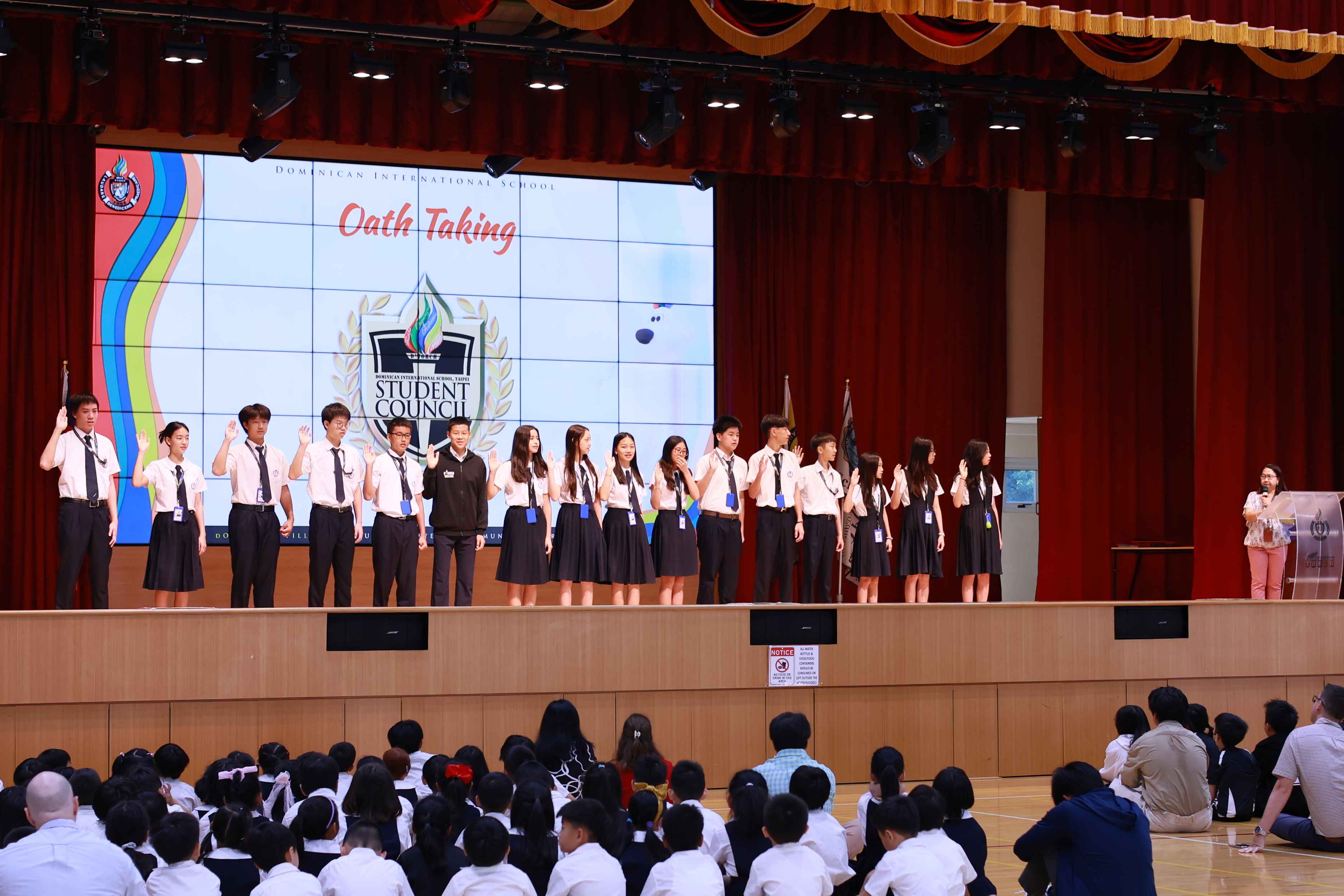
| President | Joseph Yung Lee |
| Vice-President | Julian Wang Chu |
| Secretary | Marcus Shulei Lee |
| Assistant Secretary | Dan Zuo Huang |
| Treasurer | Ian Soong |
| Assistant Treasurer | Jasper Chou |
| Public Relations Officers | Sophie Marie Luna |
| Katharine Chen | |
| Female Sports Representative | Abigail Albee Lee |
| Assistant Female Sports Representative | Rianna Hao |
| Male Sports Representative | Henry Lin |
| Assistant Male Sports Representative | Ryan Wang |
| Middle School Representative | Raymond Huang |
| Angelina Huang | |
| Olivia Chen | |
| Cara Jasmine Hunt |
| Student Council Adviser | Ms. Agosh Librea |
| Vice Principal | Sr. Rosa Dabhi, CCV |
| Directress / Principal | Sr. Jacqueline C. Manuel OP |
The Dominican International School maintains contact and positive relations with its alumni. Whether students have recently graduated, or graduated some time ago, we are always interested in their accomplishments and where their paths have taken them beyond the walls here in DIS Taipei.
DIS has created a facebook page that can be accessed by those who have been admitted to the group. This is a great resource for alumni to connect and reconnect with one another, and to explore new opportunities.
The DIS Alumni Moderators are:
Ms. Archie RacadioCelebrations on the General Calendar of the Order of Preachers
1 |
2 |
3 |
4 |
5 |
6 |
7 |
8 |
9 |
10 |
11 |
12 |
13 |
14 |
15 |
16 |
17 |
18 |
19 |
20 |
21 |
22 |
23 |
24 |
25 |
26 |
27 |
28 |
29 |
30 |
31 |
|
3 - Bl. Stephana Quinzani
4 - St. Zedislava (Berkiana) of Lemberk
10 - Bl. Gonsalvo of Amarante
11 - Bl. Bernard Scammacca
19 - Bl. Andrew of Peschiera
22 - Bl. Anthony della Chiesa
23 - Bl. Henry Suso
27 - Bl. Marolino of Forli
28 - St. Thomas Aquinas
29 - Bl. Villana de Botti
1 |
2 |
3 |
4 |
5 |
6 |
7 |
8 |
9 |
10 |
11 |
12 |
13 |
14 |
15 |
16 |
17 |
18 |
19 |
20 |
21 |
22 |
23 |
24 |
25 |
26 |
27 |
28 |
3 - Bl.Peter of Ruffia, Bl. Anthony Pavonio, Bl. Bartholomew of Cerverio
12 - Bl. Reginald of Orleans
13 - Bl. Jordan of Saxony, St. Catherine de Ricci
16 - Bl. Nicholas Paglia
18 - Bl. John of Fiesola (Fra Angelico)
19 - Bl. Alvarez of Cordoba
20 - Bl. Christopher of Milan
24 - Bl. Constantius of Fabriano
1 |
2 |
3 |
4 |
5 |
6 |
7 |
8 |
9 |
10 |
11 |
12 |
13 |
14 |
15 |
16 |
17 |
18 |
19 |
20 |
21 |
22 |
23 |
24 |
25 |
26 |
27 |
28 |
29 |
30 |
|
10 - Bl. Anthony Neyrot
13 - Bl. Margaret Castello
14 - Bl. Peter Gonsalez
17 - Bl. Clara Gambacorta, Bl. Maria Macini
19 - Bl. Isnard of Chiampo, Bl. Sibyllina Biscossi
20 - St. Agnes of Montepuciano
27 - Bl. Osanna of Kotor
28 - Saint Louis Mary Grignion de Montfort
30 - Pope St. Pius V
1 |
2 |
3 |
4 |
5 |
6 |
7 |
8 |
9 |
10 |
11 |
12 |
13 |
14 |
15 |
16 |
17 |
18 |
19 |
20 |
21 |
22 |
23 |
24 |
25 |
26 |
27 |
28 |
29 |
30 |
|
10 - Bl. Anthony Neyrot
13 - Bl. Margaret Castello
14 - Bl. Peter Gonsalez
17 - Bl. Clara Gambacorta, Bl. Maria Macini
19 - Bl. Isnard of Chiampo, Bl. Sibyllina Biscossi
20 - St. Agnes of Montepuciano
27 - Bl. Osanna of Kotor
28 - Saint Louis Mary Grignion de Montfort
30 - Pope St. Pius V
1 |
2 |
3 |
4 |
5 |
6 |
7 |
8 |
9 |
10 |
11 |
12 |
13 |
14 |
15 |
16 |
17 |
18 |
19 |
20 |
21 |
22 |
23 |
24 |
25 |
26 |
27 |
28 |
29 |
30 |
31 |
|
4 - Bl. Emily Bicchieri
7 - Bl. Albert of Bergamo
12 - Bl. Jane of Portugal, Bl. Imelda Lambertini
15 - Bl. Giles of Portugal, Bl. Andrew Abellon
21 - Bl. Columba of Rieti
27 - Bl. Andrew Franchi
28 - Bl. Mary Bartholomew Bagnesi
29 - Bl. William Arnaud
29 - Bl. James Salomonio
1 |
2 |
3 |
4 |
5 |
6 |
7 |
8 |
9 |
10 |
11 |
12 |
13 |
14 |
15 |
16 |
17 |
18 |
19 |
20 |
21 |
22 |
23 |
24 |
25 |
26 |
27 |
28 |
29 |
30 |
|
2 - Bl. Sadoc
3 - St. Peter Sanz
8 - Bl. Diana D'Andalo, Bl. Cecilia Cesarine
10 - Bl. John Dominic
12 - Bl. Stephen Bandelli
18 - Bl. Osanna of Mantua
20 - Bl. Margaret Ebner
23 - Bl. Innocent V
1 |
2 |
3 |
4 |
5 |
6 |
7 |
8 |
9 |
10 |
11 |
12 |
13 |
14 |
15 |
16 |
17 |
18 |
19 |
20 |
21 |
22 |
23 |
24 |
25 |
26 |
27 |
28 |
29 |
30 |
31 |
|
4 - Bl. Catherine Jarrige
7 - Bl. Benedict XI
8 - Bl. Adrian Fortescue
9 - Our Lady, Queen of Peace, St. John of Cologne
12 - St. Ignatius Delgado
13 - Bl. James of Varazze
24 - Bl. Jane of Orvieto, Bl. Augustine of Biella
27 - Bl. Robert Nutter
1 |
2 |
3 |
4 |
5 |
6 |
7 |
8 |
9 |
10 |
11 |
12 |
13 |
14 |
15 |
16 |
17 |
18 |
19 |
20 |
21 |
22 |
23 |
24 |
25 |
26 |
27 |
28 |
29 |
30 |
31 |
|
2 - Bl. Jane of Aza
3 - Bl. Augustine Kazotic
9 - Bl. John of Salerno
12 - Bl. Jean-Georges (Thomas) Rehm
14 - St. Domingo Ibáñez de Erquicia, Bl. Aimo Tapparelli
18 - Bl. Mannes de Guzman
19 - Bl. Jordan de Rivalto of Pisa
23 - St. Rose of Lima
26 - Bl. James of Bevagna
28 - St. Augustine of Hippo
1 |
2 |
3 |
4 |
5 |
6 |
7 |
8 |
9 |
10 |
11 |
12 |
13 |
14 |
15 |
16 |
17 |
18 |
19 |
20 |
21 |
22 |
23 |
24 |
25 |
26 |
27 |
28 |
29 |
30 |
|
2 - Bl. Guala of Bergamo
4 - Bl. Catherine Racconigi
6 - Bl. Bertrand of Garrigue
18 - St. John Macias
20 - Bl. Mark of Modena, Bl. Francis Posadas
24 - Bl. Dalmatius Moner
28 - Bl. Lawrence of Ripafratta, St. Jame Tomuaga, St. Lorenzo Ruiz
1 |
2 |
3 |
4 |
5 |
6 |
7 |
8 |
9 |
10 |
11 |
12 |
13 |
14 |
15 |
16 |
17 |
18 |
19 |
20 |
21 |
22 |
23 |
24 |
25 |
26 |
27 |
28 |
29 |
30 |
31 |
|
3 - Bl. Dominic Spadafora
5 - Bl. Raymond of Capua
6 - Bl. Bartolo Longo
8 - Bl. Ambrose Sansedoni
11 - Bl. James of Ulm
13 - Bl. Magdalen Pannatieri
19 - Bl. Agnes of Jesus Galand (of Langeac)
21 - Bl. Peter of Citta di Castello
25 - Bl. Peter of Geremia
26 - Bl. Damien of Finale
27 - Bl. Batholomew of Vincenza
30 - Bl. Benvenuta Bojani, Bl. Peter Higgins, Bl. Terrence Albert O'Brien
1 |
2 |
3 |
4 |
5 |
6 |
7 |
8 |
9 |
10 |
11 |
12 |
13 |
14 |
15 |
16 |
17 |
18 |
19 |
20 |
21 |
22 |
23 |
24 |
25 |
26 |
27 |
28 |
29 |
30 |
|
1 - St. Valentine Berrio-Ochoa
5 - Bl. Simon Ballachi
6 - Bl. Francis, Bl. Alphonsus
7 - St. Vicente Liem de la Paz
11 - St. Marina of Omura
14 - Bl. John Liccio
15 - St. Albert the Great
19 - Bl. James Benefatti
24 - Bl. Margaret of Savoy
St. Raymond was born of noble descent with ties to the Aragon family. He studied in Barcelona and Bologna, earning a doctorate in both civil and canon law. While teaching canon law in Bologna, he joined the Dominican Order at the age of 47. He even served as the Master of the Dominicans from 1238-1240. Pope Gregory IX asked for St. Raymond’s help in organizing the Church’s laws. He compiled the “Decretals of Gregory IX” which were used for almost 700 years until canon law was fully codified in 1917. St. Raymond is fittingly the patron saint of canon lawyers.

St. Margaret was born to Emperor Bela IV and Mary Lascaris in 1242. She was placed in the Monastery of Veszprem for her education and later, she received the Dominican habit in Buda. Margaret lived a life totally dedicated to Christ. She lived in total humility. She constantly fasted and refused nice clothes and royal comforts, remarking that she preferred the odor of sanctity when dead to smelling sweet only when alive. She spent her days in prayer, devotion to the Eucharist, and caring for the poor, lavishing on them whatever gifts her royal family sent her. She died in 1270, and Pope Pius XII canonized her in 1943. Her feast day is January 18.

St. Thomas is one of the most important theologians in Church history. His writings on philosophy, theology, and the law still influence us today. His most famous work is the Summa Theologiae which is a summary of all the major teachings in the Catholic Church.

Born in Florence, St. Catherine de’ Ricci came from a wealthy family. She was prayerful from a young age and developed a devotion to the Passion of Christ. She went to Tuscany to join a community of sisters of the Third Order of St. Dominic. St. Catherine took her name in honor of St. Catherine of Siena. She regularly experienced visions and ecstasies, even during mealtime. She eventually became prioress of the community and succeeded in her administrative duties. St. Catherine was known to experience the sufferings of the Passion, including spontaneous bleeding and the stigmata on her hands. While still alive, she even appeared to St. Philip Neri many miles away.

Jordan belonged to the noble German family of the Counts of Eberstein. He was born in the Castle of Borrenstrick, in the diocese of Paderborn. He began his studies in his native land, and was sent to complete them at the University of Paris. While a student he met Dominic de Guzman, the founder of the Order of Preachers, and was inspired by the preaching of Reginald of Orleans (also known as Reginald of Saint-Gilles) to join the Dominican Order. He received the habit on Ash Wednesday, 1220. Jordan was a Master of Arts and a grammarian, and taught in the schools of Paris. In 1221, a General Chapter of the Order held in Bologna appointed Jordan Prior Provincial of Lombardy in Italy. He succeeded Dominic de Guzman as Master General of the Order of Preachers when Dominic died.

St. Vincent Ferrer was a Valencian Dominican friar and preacher, who gained acclaim as a missionary and a logician. He is honored as a saint of the Catholic Church and other churches of Catholic traditions. St. Vincent preached and converted for over 20 years in Europe. He contributed to the resolution of the Western Schism, where 3 separate men claimed to be Pope. The division in the Church even led him to physical sickness. Due to his fiery preaching, his nickname is “The Angel of the Last Judgment.” Vincent died on 5 April 1419 at Vannes in Brittany, at the age of 69, and was buried in Vannes Cathedral.

St. Agnes was a Dominican prioress in the Tuscany area of Italy. At the young age of 9, she entered a Franciscan monastery. She continued to grow in holiness and prayer and was elected abbess of her community at the age of 20. She became known for performing miracles and healing the sick. There was even a report that she multiplied loaves. Despite her healings, she was often sick herself. In 1301, she returned home to Montepulciano’s community. She had a vision of St. Dominic and decided to have her nuns join the Dominican Order.

St. Catherine was both a mystic and a reformer. She was born in Siena, Italy in 1347 and wanted to devote herself to God, against the wishes of her parents. She became a Third Order Dominican, dedicated to prayer while remaining active in the world. She was famous for her mysticism and played an important role in reforming the Church. She helped influence Pope Gregory XI to return to Rome from Avignon, France. After his move, the pope encouraged her to complete many missions for him. Today, her spiritual writings The Dialogue of Divine Providence teach us about our relationship with God. She is the patron saint of Rome, Italy, and Europe. She was canonized in 1461, declared patron saint of Rome in 1866, and of Italy (together with Francis of Assisi) in 1939. She was also proclaimed patron saint of Europe in 1999 by Pope John Paul II

Pope St. Pius V was an important reformer during the Protestant Reformation. He helped implement the reforms of the Council of Trent and standardized the Roman Rite. While dealing with issues in Europe, he helped unite monarchs to defend against the invading Ottomans.

St. Antonius grew up in Florence to a wealth family and joined the Dominicans at the age of 16. He joined Bl. John Dominici’s community which promoted a more strict reform of the order. He reformed Dominican communities throughout Italy and even participated in the Council of Florence in 1439. As word spread about St. Antonius, Pope Eugene IV appointed him as Archbishop of Florence. Just as he worked for his order before, he worked for his new archdiocese. He built up his communities, spread the Gospel, taught the laity, and served the poor.

Lambertini was born in 1322 in Bologna, the only child of Count Egano Lambertini and Castora Galuzzi. Her parents were devout Catholics and were known for their charity and generosity to the underprivileged of Bologna. On her fifth birthday, she requested to receive Holy Eucharist; however the custom at the time was that children did not receive their First Holy Communion until age 14. At age nine, she went to live with the Dominican nuns at Val di pietra, near Bologna. On May 12, 1333, the day of the vigil of the Ascension, she knelt in prayer and the "Light of the Host" was reportedly witnessed above her head by the Sacristan, who then fetched the priest so he could see. After seeing this miracle, the priest felt compelled to admit her to receiving the Eucharist. Immediately after receiving it, Lambertini went back to her seat, and decided to stay after mass and pray. Later when a nun came to get Lambertini for supper, she found Lambertini still kneeling with a smile on her face. The nun called her name, but she did not stir, so she lightly tapped Imelda on the shoulder, at which Imelda collapsed to the floor dead. Her remains are kept in Bologna at the Church of San Sigismondo, beneath the wax effigy of her likeness. The cultus of this young Blessed has grown so popular that a confraternity for First Communicants has been established in her honor and the last Eucharistc Congress held in Bergamo passed a canonization.


was an Italian religious sister of the Third Order of St. Dominic who was noted as a mystic. She was renowned for her spiritual counsel, devotion to the Blessed Sacrament, and fantastic miracles were attributed to her. She was beatified by the Catholic Church in 1625.
Also known as St. Peter Martyr, St. Peter met St. Dominic when he was 15. He joined his new Dominican Order and became a famous preacher throughout all of Italy. His preaching led to many conversions in Italy, especially those who believed in the Cathar heresy. In response, Cathars from Milan conspired to assassinate St. Peter. The assassin, Carino of Balsamo, struck St. Peter in the head with an axe. He rose to his knees, recited the first part of the Apostle’s Creed, and wrote “I believe in God” on the ground in his own blood. Carino would go on to repent and join the Dominicans himself, becoming a blessed.

Diana d'Andalò was born into a powerful Roman family in Bologna, Italy in 1201. We know nothing of her childhood, but was known as a beautiful, intelligent and happy young woman. Influenced by the preaching of Blessed Reginald, she joined the Dominicans, and was received into the Order by Saint Dominic de Guzman himself, but her family forced her to stay home. She joined the Augustinians at Roxana, Italy, but was abducted and taken home by her family; Diana was injured in the abduction, but later escaped from home and returned to the Augustinians. Blessed Jordan of Saxony met with her family and convinced them that the way to keep the girl close to them was to build a Dominican convent; in 1222 they helped her found the monastery of Saint Agnes in Bologna, Italy on land her father owned. She and several other sisters, including Blessed Cecilia of Bologna and Blessed Amata of Bologna lived out their days there. Diana and Blessed Jordan kept up a correspondence that lasted for years and dozens of letters, many of which survive today.

Cecilia Cesarine began her religious life in the monastery of Santa Maria in Tempulo, Rome. In 1221 she moved with her community to San Sisto, a reformed monastery founded in that year by St. Dominic de Guzman, from whom the group received the Dominican habit and in whose hands they renewed their vows. In 1225 Cecilia and three other San Sisto nuns were sent to Bologna to the monastery of S. Agnes, newly founded by (Bl.) Jordan of Saxony and (Bl.) Diana d'Andalo, in order to establish the Dominican life there. Cecilia was prioress of St. Agnes in 1237. Her reminiscences of St. Dominic, embodying much information about the foundation of San Sisto, and including the only eyewitness description of Dominic's features, were preserved in writing by another nun c. 1280.

St. Zedislava grew up as a pious child. When she was 7, she tried to run away to a life of prayer and penance as a hermit in the woods. At 15, she was forced to marry. Her husband treated her harshly. She managed to secure enough freedom to pray and serve the poor. She also helped to support and build different hospitals, churches, and convents. Her husband even allowed her to join the Third Order of St. Dominic as a layperson. St. Zedislava experienced visions and ecstasies and even performed miracles for those around her.

Bl. Ceslaus was born in Silesia to a noble family. Ordained a priest, he became dean of the canons at Sandomierz. In 1221 while accompanying his bishop to Rome, he met St. Dominic who received him into the Order along with St. Hyacinth. A friar of great sanctity with a burning zeal for souls, he evangelized Eastern Europe, performed many miracles, and was instrumental in establishing the Province of Poland.

Mother of Saint Dominic and Blessed Mannes, Blessed Jane was born of the prominent d’Aza family and married Felix de Guzman. Three of their children spent their lives in the service of the Church: Anthony, Mannes and Dominic. An early source describes her as “virtuous, chaste, prudent, and full of compassion for the poor and the afflicted; among all the women of the region she was outstanding for her good reputation.”

Saint Dominic (Spanish: Santo Domingo), also known as Dominic of Osma and Dominic of Caleruega, often called Dominic de Guzmán and Domingo Félix de Guzmán (August 8, 1170 – August 6, 1221), was a Castilian priest and founder of the Dominican Order. Dominic is the patron saint of astronomers.

St. Hyacinth was a Polish Dominican priest and missionary. One of his miracles happened when the Mongols attacked his friary. He rushed to the tabernacle to save the Eucharist when he heard Mary ask to be taken away, too. So, he grabbed saved both the Eucharist and a heavy statue of Mary with miraculous ease. He joined the Dominicans after watching St. Dominic perform a miracle in Rome. He received the Dominican habit from St. Dominic himself and was known as the “Apostle of the North.”

Mannes, an older brother of Dominic, was contemplative and holy. He placed himself under his brothers guidance at least from the foundation of the Dominican Order and perhaps even much earlier. Mannes joined the Order and was known as a fervent preacher, virtuous in his habits, meek, humble, and kind. He later helped establish the priory of St. Jacques in Paris in 1217, and in 1219 he was entrusted with the care of the Dominican nuns at Madrid. After his death many miracles were attributed to his intercession.

St. Rose of Lima was a member of the Third Order of Saint Dominic in Lima, Peru dedicated to a life of penance and prayer.She became known for both her life of severe asceticism and her care of the needy of the city through her own private efforts. She even built a small hut for herself to pray in, leaving when it was time to go to church. A lay member of the Dominican Order, she has been declared a saint by the Catholic Church, being the first person born in the Americas to be canonized as a saint.

St. John was born in Spain and evangelized in Peru.

Francisco Martín Fernández de Posadas was born in the Kingdom of Spain on 25 November 1644 as the son of poor parents - who were war refugees - who belonged to an ancient noble household who had since declined in its status. He received his baptism in late 1644 not long after his birth. He became a noted preacher and popular confessor while being hailed as a second Vincent Ferrer and in the beginning was subjected to violent dislike and ridicule from fellow Dominicans before he was allowed to enter the order.

Lorenzo was born in Binondo, Manila, Philippines. His Chinese father taught him Chinese, and his Filipino mother taught him Tagalog. Both of his parents were Catholic. Lorenzo served at the convent of Binondo church as an altar boy. After a few years Lorenzo earned the title of "escribano" (notary). He became a member of the Confraternity of the Holy Rosary. He was working as a clerk at the Binondo Church when he was falsely accused of killing a Spaniard in 1636. Prior to that, his life with his Filipino wife and three children was one of peace, contentment, and Christ-centered. Lorenzo was falsely accused of murdering a Spaniard and sought asylum on board a ship with three Dominican priests, Saint Antonio Gonzalez, Saint Guillermo Courtet, Saint Miguel de Aozaraza, a Japanese priest: Saint Vicente Shiwozuka de la Cruz, and a layman named Saint Lazaro of Kyoto, a leper. The boat landed at Okinawa and the group was arrested on basis of their Christian religion. They were tortured by the Japanese, but did not denounce their faith, and died as martyrs. Lorenzo Ruiz was beatified in Manila on February 18, 1981 by Pope John Paul II who canonized Lorenzo on October 18, 1987. Lorenzo's beatification was the first one outside the Vatican and is the first Filipino saint.

St. Louis Bertrand was a Spanish Dominican friar who preached in South America, known as the “Apostle to the Americas.”

St. Martin was a Peruvian lay brother of the Dominicans in Lima, at the same time as St. Rose of Lima. He dedicated himself to serving the poor. His works included founding an orphanage and a children’s hospital. His miracles include levitation, bilocation, and miraculous healings.

Marina, a Dominican lay tertiary in the archdiocese of Nagasaki, Japan. In 1634, She was arrested for being Christian and host missionaries at home, and was punished to be paraded naked by all peoples of Omura, Nagasaki. She was sentenced to death along with other 68 Christians and led to the holy mountain, where she died scorched, and the ashes thrown into the sea. Martyred in the persecutions of Tokugawa Yemitsu. She was canonized in 1987.

Albertus Magnus, also known as Saint Albert the Great and Albert of Cologne, was a German Dominican friar and Catholic bishop. Later canonised as a Catholic saint, he was known during his lifetime as doctor universalis and doctor expertus and, late in his life, the term magnus was appended to his name. Scholars such as James A. Weisheipl and Joachim R. Söder have referred to him as the greatest German philosopher and theologian of the Middle Ages. The Catholic Church distinguishes him as one of the 36 Doctors of the Church. St. Albert was a German Dominican friar and bishop. Even during his lifetime, he was known as one of the top theologians and philosophers in the world. Today, he is a Doctor of the Church. His areas of study also included logic, botany, zoology, geography, and astronomy.

John was a native of Vercelli and qualified at Paris as a doctor both of civil and canon law. While he was carrying out this office at Vercelli, encouraged by the Master General Jordan, he entered the Order of Preachers. Later he founded a convent there, which he also governed as prior. Afterwards, while most religiously ruling the Province of Lombardy, he was in the year 1264 elected as sixth Master General of the Order. Austere with himself, gentle towards others, he quickly visited nearly all the Order’s convents in Europe, and for almost twenty years labored fruitfully and attentively for the good of the whole Order.

Born in Porturgal, St. Bartholomew entered the Dominican Order at the age of 13. He taught throughout Porturgal, especially in various Dominican houses. He reluctantly accepted becoming the Archbishop of Braga, Portugal in 1558. He attended and contributed to the Council of Trent, collaborating with St. Charles Borromeo. Once he returned home, he committed himself to implementing the reforms, all while caring for the poor and building hospitals.

St. John was born in Cologne, in modern day Germany. He was martyred for the faith in 1572, part of the martyrs of Gorkum.

St. Francisco was a Spanish friar who founded the Dominican Sisters of the Annunciation of the Blessed Virgin.

St. Ignatius Delgado, whose feast we celebrate on July 12, was a Spanish missionary and is now one of the martyrs of Vietnam. He was born in Villafeliche, Spain, in 1761, and was raised in a pious family. He became a Dominican priest and served as a missionary in Vietnam for almost 50 years. He was named coadjutor vicar-apostolic at East Tonkin, Vietnam. However, government-sanctioned persecution of Christians began soon after. Ignatius was arrested and locked in a cage, then put on public display for ridicule and abuse, and left to die. He died of hunger and exposure in 1838. The martyr was canonized by Pope John Paul II in 1988.

St. Dominic was one of the martyrs of Vietnam.

St. José was an Argentine priest who evangelized his country. He was known as the “cowboy priest.”

A Third Order Dominican, St. Louis was a renowned founder and preacher. He founded both the Company of Mary and the Daughters of Wisdom. His most famous works are Secret of the Rosary and True Devotion to Mary. Pope Clement XI even left him with the title of “Apostolic Missionary.”

St. Peter was a Spanish missionary to China, where he was martyred.

St. Vicente was born in North Vietnam to Christian parents. He was martyred for the faith.

St. Domingo was born in Spain and evangelized in the Philippines. After he went to Japan, he was martyred for the faith.

Bishop and martyr of Vietnam. A native of Ellorio, Spain, he entered the Dominican Order and was sent to the Philippines. From there he went to Vietnam in 1858, serving as a vicar apostolic and titular bishop until betrayed by an apostate. He was martyred by beheading with St. Jerome Hermosilla and Blessed Peter Amato, by enemies of the Church. He was canonized in 1988 by Pope John Paul II.

